

“Men are disturbed not by things, but by the view which they take of them.” (Epictetus, The Enchiridion).
CBT explores how we interpret what happens to us (cognitive), how we feel and how we then respond (behaviour). Our interpretations are often biased, leading to anxiety and depression, and difficulties in our relationships and life choices.
Cognitive Behavioural Therapy is effective in the treatment of anxiety and depression. It teaches you skills to recognise and challenge your thinking and behaviour so that you can discover more helpful ways of coping in all aspects of your life. CBT is a powerful, collaborative approach where you learn to become the best therapist for yourself, even after therapy has ended.
Research shows that not only do people recover from anxiety and depression using CBT, they maintain changes made in therapy throughout their lives. This ground-breaking evidence demonstrates the additional value of this time-limited approach.
“I recently completed therapy for anxiety and excessive worrying, and it’s made a significant difference in my life. The treatment helped me understand the triggers behind my anxiety and taught me practical tools to manage overthinking and stress.”
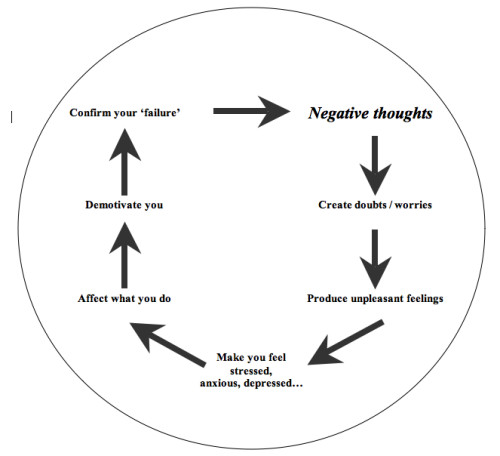
A typical CBT cycle
Negative thoughts like “I’m not good enough”, can lead to feelings of anxiety, that has a strong reaction in the body. When we feel anxious we might feel tense, on edge, sweaty, sick and we may worry a lot. These body sensations and worry causes us to focus more on whether or not we are going to make a mistake, or on other reasons that tell us we are not good enough. We may try extra hard not to make mistakes like spending long hours on work, checking things again and again, or even avoiding situations that we could possibly make mistakes in. When focused on whether or not we make mistakes, we become hyper-alert to any small error, and when, as is natural, an error is made, this is taken to confirm the original thought. ” See! I knew I would make a mistake, I can never get anything right, I’m not up to this.” We may feel low or depressed as this thought seems truer than ever.
Learning to spot negative thoughts and our responses before we get dragged into the pattern, helps us to challenge them and try new ways of thinking and behaving that are more helpful to us.
What does CBT therapy involve?
CBT aims to develop more helpful thoughts and behaviours that can guide us to happier, more fulfilling lives.
CBT is a collaborative approach. You and the therapist work together to become more aware of how you think and interpret events (cognitions). Together, you become aware of how these interpretations may not be helpful. You develop the skills needed to challenge thoughts and then how you respond with ‘cognitive restructuring’ or ‘exposure response prevention’, to bring about lasting behavioural and emotional change. The skills learnt in therapy are tools for life, helping you to challenge any future obstacles that may arise. The therapy offers a safe, confidential and supportive space.
How CBT therapy works (3-4 min)
What you can expect from CBT therapy
A typical course of CBT lasts between 6-20 sessions, depending on the nature of the problem. After the initial consultation you will set some goals to work towards in therapy. Your progress towards achieving these goals will be regularly reviewed to ensure treatment stays on track and that you are getting best value from the sessions.
A typical CBT therapy session involves reviewing recent events, identifying thoughts and behaviours and setting up experiments to challenge your thoughts and practice new ways of responding.
Between session tasks are an essential part of CBT. Completing tasks related to your session improve the effectiveness of CBT.
Tasks are generated by you and the therapist, and it would be with your full participation, at your own pace. These may range from reading, keeping short records about the problem, to setting yourself some experiments to try new ways of approaching difficulties. The out of session work is a chance to really see the problem in context. Research shows shows that people who do out of session work get better results from treatment.
Conditions and issues CBT therapy can help to treat
The National Institute for Clinical Excellence (NICE) guidelines recommend CBT works as a treatment for:
- anxiety
- depression
- generalised anxiety/excessive worry
- social anxiety
- family issues
- trauma
- low self-esteem
- obsessions and compulsions (Obssessive Compulsive Disorder)
- intrusive thoughts, images and memories
- health anxiety
- body image anxiety (Body Dysmorphic Disorder)
- post traumatic stress (PTSD)
- covid anxiety and trauma
- work-place trauma
- panic attacks
- phobias (including needles, blood, animals, heights, driving etc)
- low self-esteem
- pregnancy depression and anxiety
- birth trauma
- postnatal depression
- addiction
- attachment and relationship difficulties
- perfectionism
- bereavement
The therapist will explore how the particular difficulties affect you as an individual on a day to day basis, and how you have been attempting to best cope. The therapist will work with you to find the best solutions for you.
What if CBT therapy doesn’t work for me?
Sometimes CBT needs to be adapted or combined with other methods. If progress stalls we might integrate Schema Therapy, Mindfulness Based Cognitive Therapy, Compassion Focused Therapy and EMDR.
I will work with you to establish the methods that best fits with you, while ensuring that you receive evidence-based therapy that best meets your needs.